

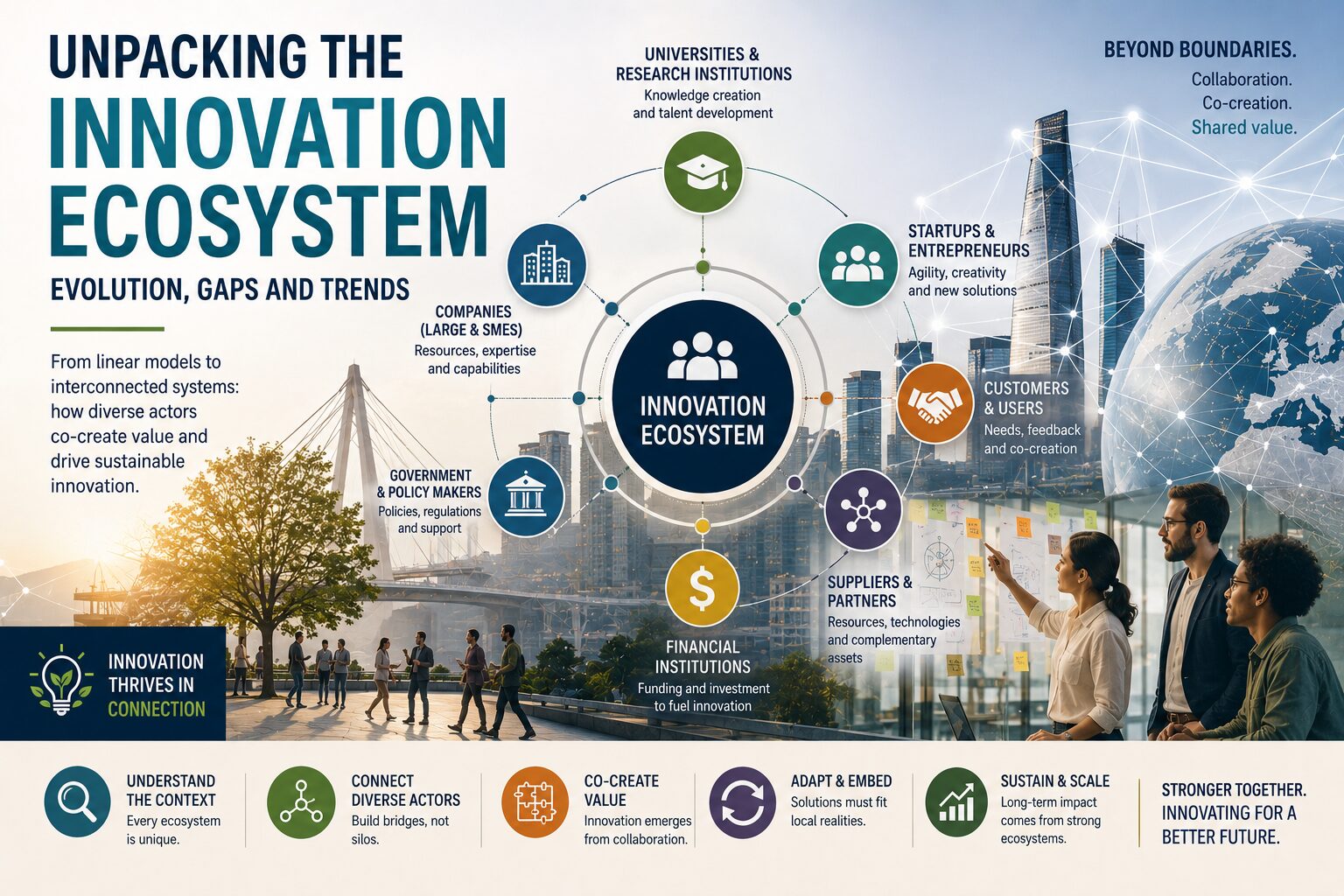
This research systematically maps the evolution of the 'innovation ecosystem' concept, revealing its multidisciplinary roots and identifying key components and relationships that define successful innovation environments. It highlights a shift from linear innovation models to complex, interconnected systems where diverse actors co-create value.
Managerial implication
Managers should move beyond a narrow view of their organization's boundaries, actively cultivating and leveraging a diverse network of partners, including customers, suppliers, competitors, universities, and government. Understanding the dynamics of these relationships is crucial for fostering sustainable innovation and competitive advantage.
Broader relevance
In an increasingly interconnected and rapidly changing global economy, the ability to innovate is paramount for survival and growth across all industries and sectors. This understanding of innovation ecosystems provides a framework for navigating complexity and building resilient, future-proof organizations and regions.
Overview
Innovation is no longer a solitary pursuit confined within the walls of a single company. Today, it thrives in dynamic, interconnected environments we call 'innovation ecosystems.' But what exactly constitutes an innovation ecosystem, and how has this concept evolved to become such a central theme in business and policy discussions?
Understanding these ecosystems is crucial for any manager or entrepreneur aiming to innovate effectively. It's about recognizing that your organization's success is deeply intertwined with a broader network of collaborators, competitors, and institutions. This blog post delves into the academic understanding of innovation ecosystems to provide practical insights for fostering a thriving innovative environment.
What This Research Is About
The paper, "Unpacking the innovation ecosystem construct: Evolution, gaps and trends," by Gomes, Facin, Salerno, and Ikenami, undertakes a comprehensive literature review to trace the development of the innovation ecosystem concept. Published in TECHNOLOGICAL FORECASTING AND SOCIAL CHANGE, a Tier 1A journal, this study provides a robust foundation for understanding this complex phenomenon.
The authors meticulously analyzed a vast body of academic literature, identifying key definitions, theoretical underpinnings, and the various components attributed to innovation ecosystems over time. Their methodology involved a systematic review to synthesize existing knowledge, pinpointing conceptual gaps and emerging trends in the field. The scope of their research was broad, encompassing contributions from economics, management, and policy studies, providing a holistic view of the construct.
What the Study Found
The research reveals that the innovation ecosystem construct has evolved significantly, moving from initial conceptualizations rooted in biological analogies to a more nuanced understanding of interconnected actors and their roles. Key findings include:
- Multidisciplinary Origins: The concept draws heavily from various fields, including business ecosystems, national innovation systems, and regional innovation systems, highlighting its complex, interdisciplinary nature.
- Dynamic Evolution: The definition and components of innovation ecosystems are not static; they adapt to technological advancements, globalization, and changing economic landscapes.
- Key Components: While definitions vary, common elements consistently emerge, such as firms (startups, SMEs, large corporations), universities, research institutions, government agencies, financial institutions, and supporting infrastructure.
- Interdependencies and Co-evolution: A critical insight is the recognition of strong interdependencies among these actors, where their co-evolution and collaboration drive the overall innovation capacity of the system.
- Value Co-creation: Innovation ecosystems are characterized by the collective creation and capture of value, where no single actor can achieve significant innovation in isolation.
The study also highlights a trend towards understanding the governance and management of these ecosystems, moving beyond mere description to prescriptive insights on how to foster and sustain them.
What It Means in Practice
For managers and entrepreneurs, understanding innovation ecosystems means shifting from a traditional, internal-focused view of innovation to one that embraces external collaboration and network building. Don't just look at your direct competitors; consider the entire landscape of partners, suppliers, customers, and even regulatory bodies that influence your innovation potential.
Actively engage in ecosystem building by fostering relationships with universities for research, collaborating with startups for agile solutions, and participating in industry clusters or associations. Your role is not just to innovate within your company, but to contribute to and draw from the collective intelligence and resources of the broader ecosystem. This involves open innovation practices, strategic alliances, and even co-opetition.
Furthermore, consider how your organization can contribute to the health and vibrancy of the ecosystem. Are you mentoring startups? Sharing knowledge? Investing in local talent development? A healthy ecosystem benefits all its participants, including your own firm. Proactive engagement and a collaborative mindset are key to leveraging the power of these interconnected innovation networks.
Why This Matters for Scholars
This paper makes a significant theoretical contribution by synthesizing and clarifying the innovation ecosystem construct, which has often suffered from definitional ambiguity. It provides a robust framework for future research by identifying key dimensions and relationships that warrant further empirical investigation. The systematic review approach itself serves as a model for conceptual development in nascent fields.
Future research could delve deeper into the governance mechanisms of diverse innovation ecosystems, exploring how trust, power dynamics, and institutional arrangements influence their effectiveness. There's also a need for more empirical studies that quantitatively measure the impact of different ecosystem configurations on innovation outcomes across various industries and geographical contexts. Understanding how to measure and manage the health of an innovation ecosystem remains a fertile ground for academic inquiry.
Final Takeaway
The core message for any leader is clear: innovation is a team sport, played on a much larger field than just your organization. Embrace the concept of the innovation ecosystem, understand its components, and actively participate in its development.
By strategically engaging with diverse actors – from universities to startups, and even your competitors – you can unlock new opportunities, accelerate innovation, and build a more resilient and future-proof business. The future of innovation lies in collaboration, not isolation.
Comments are closed