

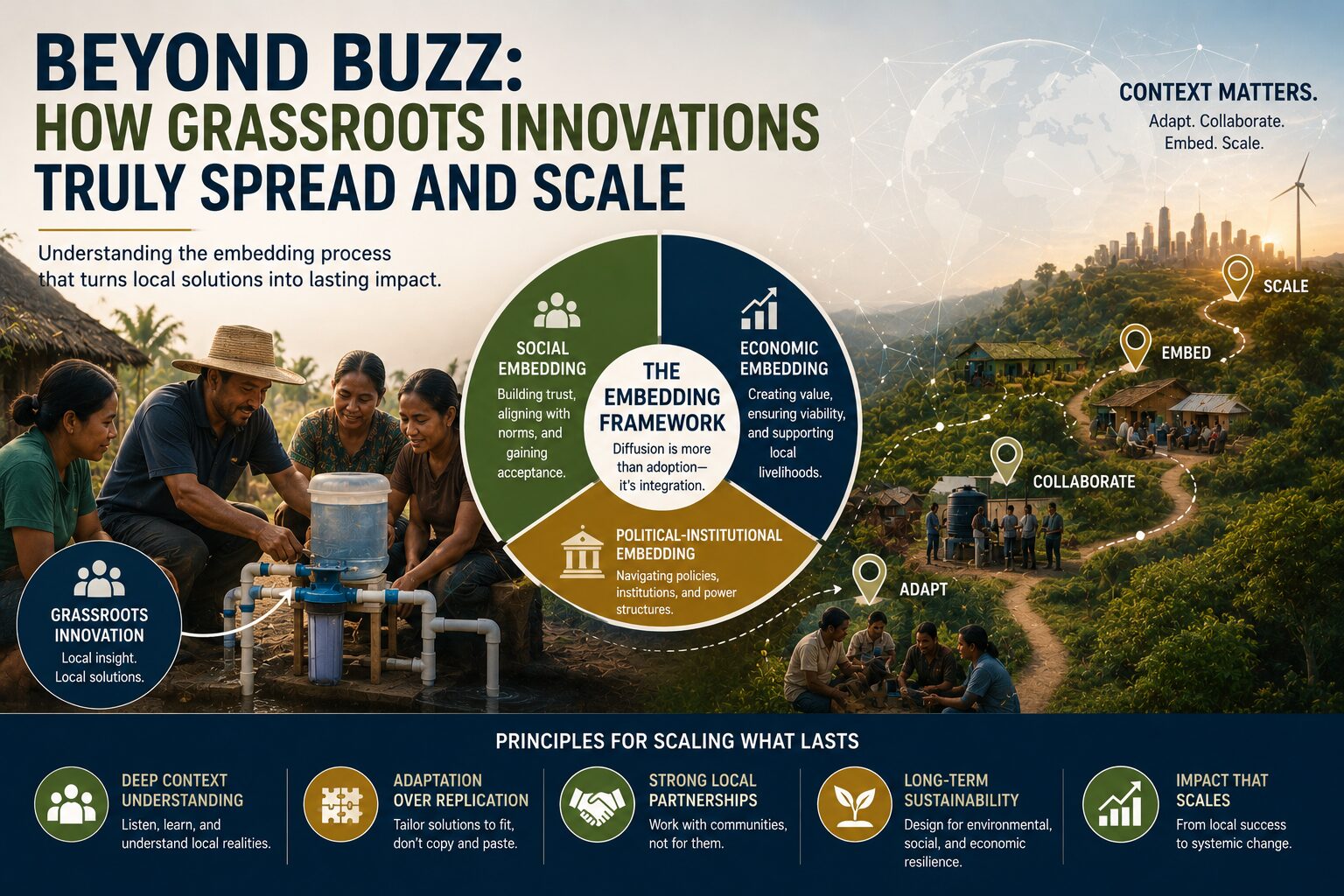
This research introduces an 'embedding framework' to explain how grassroots innovations diffuse, highlighting that their spread isn't just about adoption but also about how they integrate into new social, economic, and political contexts. It emphasizes that successful diffusion requires careful adaptation and negotiation within existing structures, rather than simply replicating a solution.
Managerial implication
Managers seeking to scale grassroots solutions should focus on understanding and adapting their innovations to the specific 'embedding contexts' of new environments. This means going beyond mere technical transfer to consider the social, cultural, and political nuances that influence acceptance and sustainability.
Broader relevance
Understanding the embedding process of grassroots innovations offers critical insights for sustainable development, social entrepreneurship, and global innovation strategies. It underscores that truly impactful solutions are those that can be meaningfully integrated into diverse local realities, fostering resilience and local ownership.
Overview
Grassroots innovations often emerge from the ground up, designed by communities to solve local problems with limited resources. These ingenious solutions, from DIY energy systems to community-led healthcare initiatives, hold immense potential for addressing global challenges, particularly in resource-constrained settings. However, their diffusion and scaling often prove more complex than simply replicating a successful model elsewhere.
Traditional views of innovation diffusion tend to focus on the 'what' – the product or service itself – and the 'how' – the channels of communication. But when it comes to grassroots efforts, the 'where' and 'who' are equally, if not more, critical. This new research challenges us to look beyond simple adoption rates and consider the intricate process by which these innovations become truly integrated into new environments.
What This Research Is About
The paper, "Rethinking the diffusion of grassroots innovations: An embedding framework," by Roysen et al. (2024), tackles the critical question of how grassroots innovations actually spread and become sustainable. It argues that existing diffusion theories often fall short because they don't adequately account for the unique, context-dependent nature of these innovations.
The authors propose an 'embedding framework' that moves beyond linear diffusion models. They conducted a systematic literature review, analyzing a wide range of studies on grassroots innovation diffusion. This qualitative synthesis allowed them to identify recurring patterns and develop a more nuanced understanding of the processes involved in their spread and integration.
The research scopes out to understand not just the initial adoption, but the deeper, more complex process of how an innovation becomes 'embedded' within a new context. This involves examining the interactions between the innovation, its proponents, and the various social, economic, and political structures of the receiving environment.
What the Study Found
The core finding is the introduction of the 'embedding framework,' which posits that the diffusion of grassroots innovations is not a simple transfer but a dynamic process of integration and adaptation. This framework highlights three key dimensions of embedding:
- Social Embedding: This refers to how the innovation integrates into existing social networks, cultural norms, and community practices. It involves building trust, gaining acceptance from local stakeholders, and aligning with community values.
- Economic Embedding: This dimension focuses on the innovation's integration into local economic structures, including its financial viability, resource mobilization, and impact on livelihoods. It considers how the innovation generates value and sustains itself within the local economy.
- Political-Institutional Embedding: This involves the innovation's interaction with local governance, policies, and regulatory frameworks. It addresses how the innovation navigates power structures, secures institutional support, and potentially influences policy changes.
The research emphasizes that these three dimensions are interconnected and often require significant negotiation and adaptation. Successful diffusion, therefore, is less about direct replication and more about a continuous process of mutual adjustment between the innovation and its new context. This often involves modifying the innovation itself, as well as influencing the receiving environment to create a supportive ecosystem.
What It Means in Practice
For managers and entrepreneurs looking to scale grassroots innovations, this framework offers crucial insights. First, don't assume a one-size-fits-all approach. What worked in one community may need significant adaptation in another. Invest time in understanding the specific social, economic, and political landscape of your target communities before attempting to introduce an innovation.
Second, focus on building strong local partnerships. Social embedding is paramount; engage community leaders, local organizations, and potential users early in the process. Their involvement is critical for gaining trust, ensuring cultural relevance, and facilitating genuine adoption. Third, consider the long-term sustainability from an economic and institutional perspective. How will the innovation be financed? What local policies or regulations might impact its success? Proactively address these questions to foster lasting impact.
Finally, be prepared for an iterative process. Embedding an innovation is not a single event but an ongoing journey of learning, adapting, and negotiating. Embrace flexibility and be willing to modify your approach based on feedback from the ground. This 'adaptive scaling' is far more effective than rigid replication.
Why This Matters for Scholars
This paper makes a significant theoretical contribution by moving beyond traditional, linear models of innovation diffusion, which often overlook the complexities inherent in grassroots contexts. By introducing the 'embedding framework,' it provides a more robust and nuanced lens through which to analyze how innovations, particularly those originating from the grassroots, integrate into diverse socio-technical systems. It bridges gaps between diffusion theory, social practice theory, and institutional theory, offering a holistic perspective.
Future research could empirically test the proposed embedding framework across a wider range of grassroots innovations and geographical contexts, perhaps developing quantitative measures for each embedding dimension. Further exploration into the dynamic interplay and potential trade-offs between social, economic, and political-institutional embedding would also be valuable. This framework also opens avenues for studying how different types of intermediaries facilitate or hinder the embedding process.
Final Takeaway
The key takeaway for anyone involved in innovation, especially those working with grassroots solutions, is that diffusion is not just about spreading an idea; it's about deeply embedding it. It's about making an innovation truly belong in its new home, adapting to its unique rhythms and structures. This requires a profound understanding of local contexts and a commitment to collaborative, adaptive strategies.
By focusing on social, economic, and political-institutional embedding, we can move beyond superficial adoption to foster innovations that are not only effective but also sustainable, locally owned, and truly transformative. This approach ensures that grassroots ingenuity can achieve its full potential in addressing the world's most pressing challenges.
Comments are closed