

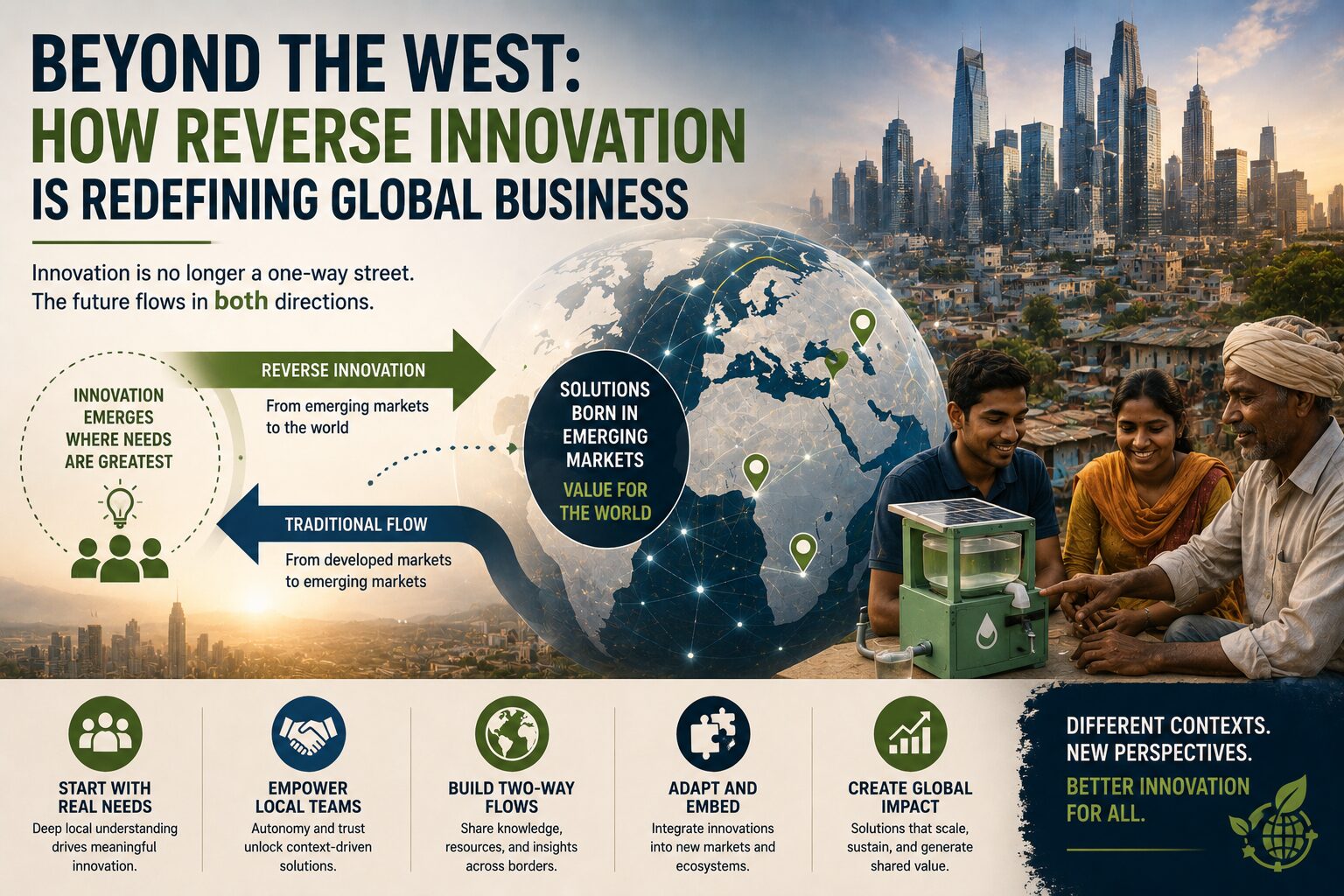
This research highlights that reverse innovation isn't just about adapting existing products for emerging markets; it's about fundamentally rethinking the innovation process, starting with the unique needs of these markets. It emphasizes that this 'reverse flow' of innovation from developing to developed countries is a strategic imperative, not just a niche strategy. The study identifies key drivers and challenges for companies embracing this paradigm shift.
Managerial implication
Managers should actively seek out unmet needs in emerging markets as fertile ground for novel solutions, rather than just as new sales territories. They need to foster organizational structures and cultures that support a two-way flow of knowledge and resources, empowering local teams to innovate and championing these innovations globally. This means moving beyond a 'one-size-fits-all' global strategy.
Broader relevance
In an increasingly interconnected world, understanding reverse innovation is crucial for sustained global competitiveness and fostering inclusive growth. It challenges traditional notions of where innovation originates and demonstrates how solutions developed under resource constraints can offer superior value worldwide. This approach can unlock new markets and address global challenges more effectively.
Overview
For decades, the innovation playbook was clear: develop sophisticated products in advanced economies, then adapt them for emerging markets. This traditional 'trickle-down' model, however, is being challenged by a powerful new paradigm: reverse innovation. Instead of simply pushing products from West to East, companies are now discovering that groundbreaking solutions, often born out of necessity and resource scarcity in developing countries, can find immense value and application in wealthier nations.
Reverse innovation isn't merely a cost-cutting exercise or a simplified version of existing technology; it represents a fundamental shift in how organizations approach product development, market understanding, and global strategy. It acknowledges that the unique constraints and demands of emerging markets can foster truly novel and often more robust, affordable, and sustainable innovations. This blog post delves into a key academic paper that unpacks this exciting phenomenon, offering insights for managers navigating this evolving global landscape.
What This Research Is About
The paper, "Reversing Gears Inverting the Innovation-Flow Paradigm with Reverse Innovation," by von Janda, Schuhmacher, and Kuester, examines the concept of reverse innovation in depth. It aims to provide a clearer understanding of what reverse innovation entails, distinguishing it from related concepts like frugal innovation and glocalization. The authors explore the motivations behind companies adopting this strategy and the specific challenges they face.
The research synthesizes existing literature and conceptualizes reverse innovation as a distinct strategic approach. While not an empirical study in the traditional sense, it builds a robust theoretical framework by analyzing various case studies and industry examples. The scope is broad, covering different industries and geographical contexts to illustrate the diverse applications and implications of this innovation model. The authors meticulously define the key characteristics that differentiate reverse innovation from other innovation strategies.
What the Study Found
The paper identifies several critical findings regarding reverse innovation. Firstly, it clarifies that reverse innovation is not simply about 'frugal' or 'low-cost' innovation, but rather about developing solutions specifically for emerging markets that then gain traction in developed markets due to their superior value proposition (e.g., affordability, simplicity, robustness). These innovations often address an 'unmet need' in developed markets that conventional solutions have overlooked.
- Drivers for Reverse Innovation: Companies are motivated by the immense growth potential in emerging markets, the need for sustainable competitive advantage, and the realization that traditional products often fail to meet local needs.
- Key Success Factors: Establishing dedicated local teams with significant autonomy, fostering a deep understanding of local customer needs, and securing top management commitment are crucial.
- Challenges: Overcoming organizational resistance to ideas from 'less developed' regions, managing complex global supply chains, and integrating these innovations into the broader product portfolio are significant hurdles.
- Organizational Implications: Successful reverse innovation often requires a decentralized organizational structure, a culture that values diverse perspectives, and a willingness to challenge established norms.
The research emphasizes that the 'reverse' flow is not accidental but a result of deliberate strategic choices and organizational design. It requires a fundamental shift in mindset from a 'global product adaptation' approach to a 'local product creation for global impact' approach.
What It Means in Practice
For managers and entrepreneurs, embracing reverse innovation means fundamentally rethinking where and how innovation happens. Instead of viewing emerging markets merely as recipients of innovation, they should be seen as fertile ground for generating new ideas and solutions. This requires investing in local R&D capabilities and empowering local teams to identify and solve problems unique to their contexts, without being constrained by existing global product lines.
Organizations need to foster a culture that values learning from diverse markets and is open to adopting solutions that may not fit traditional Western product development paradigms. This includes creating channels for knowledge transfer from emerging market teams to headquarters and ensuring that these 'reverse' innovations are given the resources and visibility to succeed globally. Breaking down internal silos and encouraging cross-cultural collaboration are also vital.
Furthermore, managers should actively scan developed markets for 'unmet needs' that could be addressed by simpler, more robust, or more affordable solutions originating from emerging markets. This often involves identifying overlooked customer segments or situations where existing high-end solutions are over-engineered or too costly. The success of reverse innovation lies in its ability to offer a compelling value proposition across different economic contexts.
Why This Matters for Scholars
This paper makes a significant theoretical contribution by clearly delineating reverse innovation from related concepts like frugal innovation, glocalization, and bottom-of-the-pyramid strategies. It provides a robust conceptual framework that helps scholars better categorize and analyze different innovation flows. By highlighting the strategic intent and organizational requirements, it enriches our understanding of how multinational corporations can navigate global innovation challenges.
For future research, scholars could empirically test the proposed success factors and challenges across a wider range of industries and firm sizes. There's also a need to explore the long-term impact of reverse innovation on organizational structures, corporate culture, and the competitive landscape. Further investigation into the specific mechanisms of knowledge transfer and integration of reverse innovations within global portfolios would also be highly valuable.
Final Takeaway
The core message is clear: reverse innovation is not a fleeting trend but a powerful strategic imperative for companies seeking sustainable growth and global relevance. It challenges the conventional wisdom that innovation flows primarily from developed to developing nations, demonstrating the immense value that can be unlocked by looking at the world differently.
By intentionally seeking out and nurturing innovations born in resource-constrained environments, businesses can create products and services that are not only successful in emerging markets but also offer compelling solutions for customers worldwide. This requires a proactive shift in mindset, organizational structure, and strategic focus, but the rewards – in terms of market expansion, enhanced competitiveness, and global impact – are substantial.
Comments are closed