

📋 In a Nutshell
Insight
In African SMEs, traditional HR development models often fall short due to limited resources. However, entrepreneurial leadership can serve as a catalyst for human resource development, even in the most constrained environments.
Managerial Implication
For SME owners and managers, adopting an entrepreneurial leadership approach can help overcome resource constraints and foster a culture of continuous learning and growth. By embracing informal HRD mechanisms, they can develop their employees’ skills and competencies without relying on formal training programs.
Broader Relevance
The findings of this research have significant implications for emerging economies, where SMEs play a vital role in driving economic growth and development. By promoting entrepreneurial leadership and informal HRD, policymakers and business leaders can help create a more sustainable and competitive business environment.
Overview
Imagine running a small business in a resource-constrained environment, where access to formal training and development programs is limited. This is the reality for many SME owners in Africa, who must find innovative ways to develop their employees’ skills and competencies. One such approach is entrepreneurial leadership, which can help catalyze human resource development even in the most challenging environments.
In Zimbabwe, for example, SMEs are a crucial part of the economy, providing employment and income opportunities for thousands of people. However, these businesses often struggle to access the resources they need to grow and develop, including funding, technology, and talent. By adopting an entrepreneurial leadership approach, SME owners can help overcome these challenges and create a more sustainable and competitive business environment.
What This Research Is About
This research was conducted by Getrude Mavunga and published in the Journal of Management Sciences, Innovation, and Technology. The study draws on Complexity Leadership Theory (CLT) and Afrocentric leadership philosophies to develop an integrative conceptual framework explaining how entrepreneurial leadership catalyzes HRD in Zimbabwean SMEs.
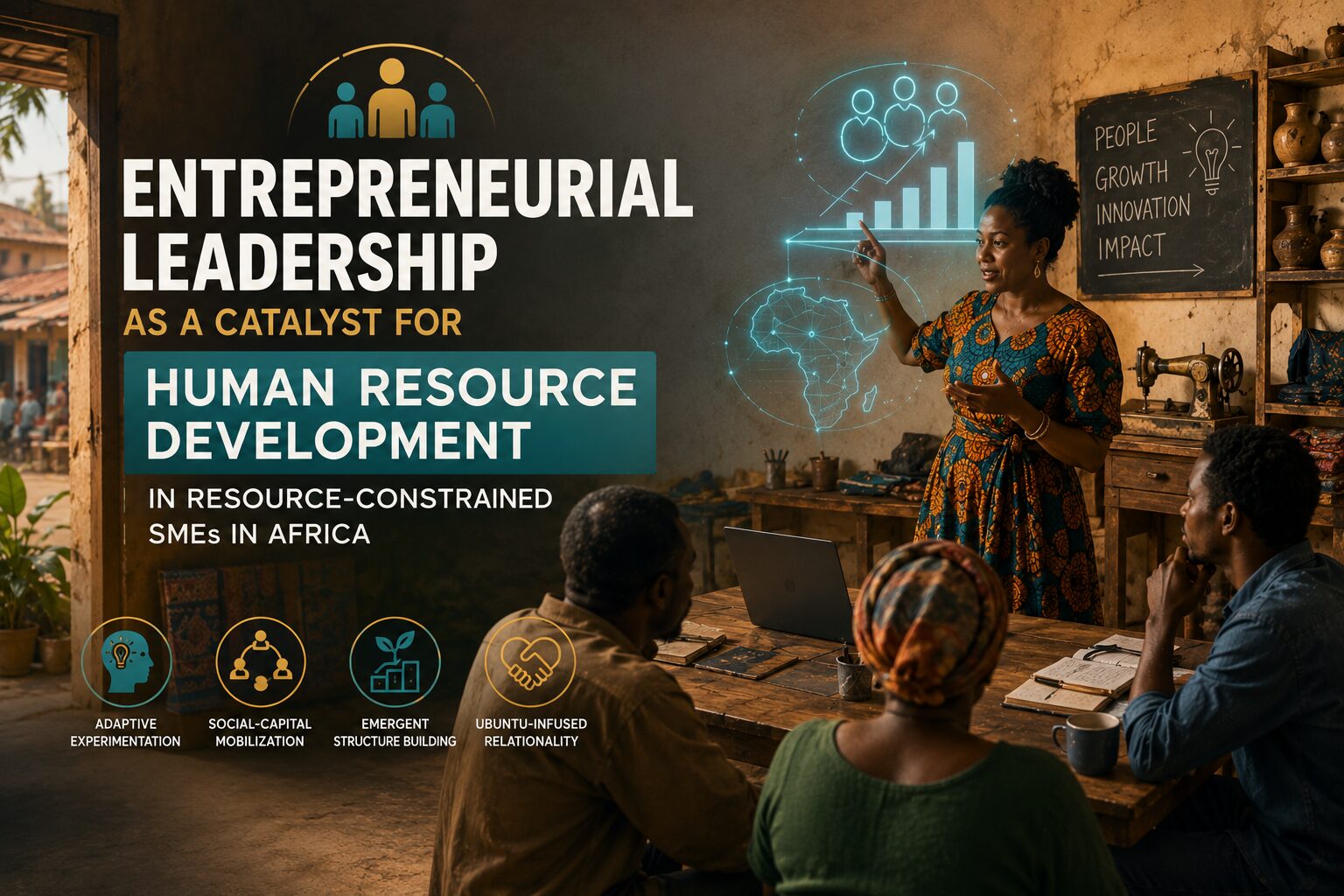
The research involved a systematic literature synthesis of 85 core sources, including leadership theory, indigenous African perspectives, and empirical studies of informal learning. The study identifies four leadership functions that give rise to informal HRD mechanisms, including adaptive experimentation, social-capital mobilization, emergent structure building, and ubuntu-infused relationality.
What the Study Found
- The research identifies four leadership functions that catalyze HRD in resource-constrained SMEs: adaptive experimentation, social-capital mobilization, emergent structure building, and ubuntu-infused relationality.
- Informal HRD mechanisms, such as experiential learning cycles, peer coaching, problem-solving forums, and narrative exchange, can generate distributed learning capacity, adaptive competence, and cultural-structural alignment.
- The study proposes a mixed-methods empirical validation of the model, combining structured surveys with in-depth interviews to test its propositions and refine its constructs.
What It Means in Practice
So, what does this mean for SME owners and managers who want to adopt an entrepreneurial leadership approach and foster a culture of continuous learning and growth? The findings of this research offer several practical insights and recommendations.
Firstly, SME owners should focus on developing their leadership skills and adopting an entrepreneurial mindset. This involves being open to new ideas, taking calculated risks, and experimenting with innovative approaches to HRD. By doing so, they can create a culture of continuous learning and growth, where employees are empowered to develop their skills and competencies.
Secondly, SME owners should prioritize informal HRD mechanisms, such as experiential learning cycles, peer coaching, and problem-solving forums. These approaches can help generate distributed learning capacity, adaptive competence, and cultural-structural alignment, even in the most resource-constrained environments. By leveraging these mechanisms, SME owners can develop their employees’ skills and competencies without relying on formal training programs.
Finally, SME owners should recognize the importance of cultural authenticity and resource efficiency in HRD. By embracing Afrocentric leadership philosophies and indigenous African perspectives, they can develop HRD approaches that are tailored to their specific context and needs. This involves being sensitive to the cultural and social nuances of their environment and adapting their HRD strategies accordingly.
Why This Matters for Scholars
For scholars, this research contributes to the theoretical understanding of entrepreneurial leadership and HRD in resource-constrained environments. The study provides a framework for analyzing the complex interactions between leadership, culture, and HRD, and offers insights for future research in this area. By exploring the cultural authenticity and resource efficiency of emergent HRD, scholars can develop more nuanced and context-specific theories of HRD that are relevant to emerging economies.
Final Takeaway
In conclusion, entrepreneurial leadership can be a powerful catalyst for human resource development in resource-constrained SMEs. By adopting an entrepreneurial mindset, prioritizing informal HRD mechanisms, and recognizing the importance of cultural authenticity and resource efficiency, SME owners can create a culture of continuous learning and growth that drives business success and sustainability.
📖 Original Article
Mavunga, G. (2026). Entrepreneurial Leadership as a Catalyst for Human Resource Development in Resource-Constrained SMEs in Africa. Journal of Management Sciences, Innovation, and Technology, 2(1), 1-12. https://doi.org/10.63726/jmsit.v2i1.279
Comments are closed