

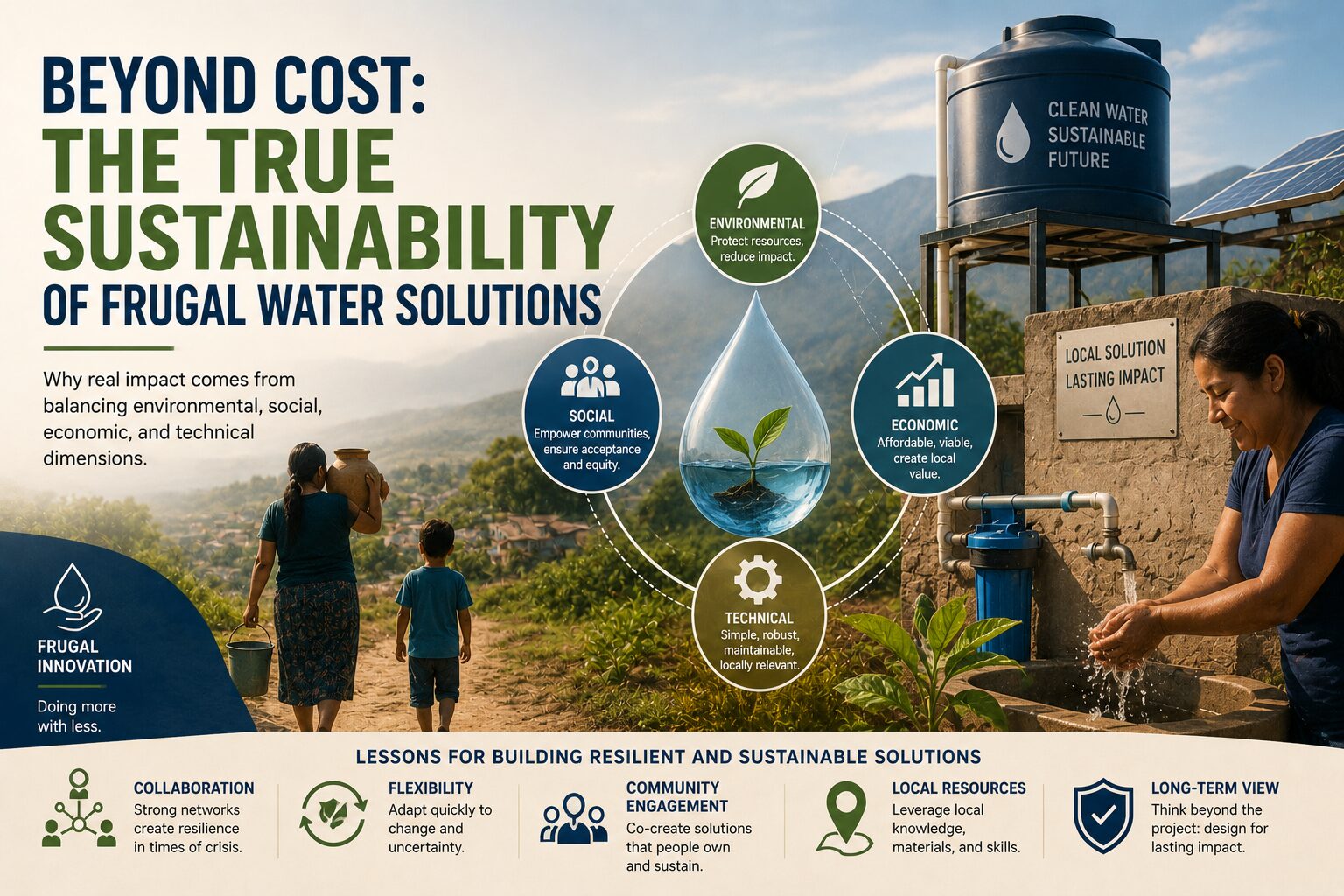
Frugal innovations, especially in critical sectors like water, are not just about being affordable; their long-term sustainability hinges on a complex interplay of environmental, social, and economic factors. This research highlights that a narrow focus on cost-effectiveness can overlook crucial elements for lasting impact.
Managerial implication
Managers leading frugal innovation initiatives must adopt a holistic sustainability lens, moving beyond initial cost savings to consider the entire lifecycle and community integration. Prioritize solutions that are not only affordable but also environmentally benign, socially accepted, and economically viable for local communities.
Broader relevance
This insight extends beyond water solutions to any frugal innovation aimed at addressing grand challenges in emerging markets or underserved communities globally. Understanding the multi-dimensional nature of sustainability is crucial for ensuring that these innovations deliver genuine, long-term value and avoid unintended negative consequences.
Overview
When we talk about frugal innovation, the immediate thought often goes to 'doing more with less' or 'affordable solutions.' While cost-effectiveness is undoubtedly a cornerstone, a deeper question emerges: are these innovations truly sustainable in the long run? This is particularly critical in sectors like water, where solutions directly impact human health, environmental well-being, and economic stability.
Addressing water scarcity and quality issues in emerging economies often calls for innovative, low-cost approaches. However, simply being 'frugal' doesn't automatically equate to 'sustainable.' We need to understand the broader implications and ensure that these ingenious solutions don't create new problems down the line or fail to deliver lasting benefits to the communities they aim to serve.
What This Research Is About
The paper, "Understanding and evaluating the sustainability of frugal water innovations in Mexico: An exploratory case study," delves into this crucial distinction. The authors sought to understand what makes frugal water innovations truly sustainable and how to evaluate them comprehensively. Their core research question revolved around identifying the key dimensions of sustainability for such innovations.
To achieve this, the researchers employed an exploratory case study approach, focusing on specific frugal water innovations implemented in Mexico. They utilized a qualitative methodology, likely involving interviews with developers, implementers, and beneficiaries, alongside document analysis. This allowed for an in-depth examination of the real-world challenges and successes associated with these innovations.
The scope of the research was to move beyond a purely economic or technological assessment, aiming for a holistic view that integrates environmental, social, and economic factors. By focusing on Mexico, the study provided context-specific insights while offering generalizable lessons for other emerging markets grappling with similar water challenges.
What the Study Found
The study revealed that the sustainability of frugal water innovations is multi-faceted and requires a balanced approach across several dimensions. It's not enough to just be cheap; the solution must also be robust and accepted by the community.
- Environmental Sustainability: This dimension includes factors like minimal resource consumption, low energy footprint, and the use of locally available, non-toxic materials. The innovations must not create new environmental burdens.
- Social Sustainability: Crucial aspects here are user acceptance, community participation in design and maintenance, affordability for target users, and equitable access. Solutions that don't consider local customs or empower users often fail.
- Economic Sustainability: Beyond initial low cost, this involves operational affordability, local economic benefits (e.g., job creation, local supply chains), and the potential for financial viability or self-sufficiency over time. Dependence on external funding for maintenance can undermine long-term success.
- Technical Sustainability: While not explicitly a 'sustainability' pillar in the traditional sense, the study implicitly highlights the need for simple, robust, and easily maintainable technology using locally available skills and parts.
The research underscored that a strong focus on one dimension, like economic affordability, without adequate attention to the others, often leads to unsustainable outcomes. For instance, a very cheap solution that is difficult to maintain or socially unacceptable will ultimately fail.
What It Means in Practice
For managers and entrepreneurs venturing into frugal innovation, especially in vital sectors like water, this research offers a critical roadmap. First, shift your mindset from merely 'low-cost' to 'holistically sustainable.' This means integrating environmental impact assessments, social acceptance studies, and long-term economic viability plans from the outset of your project.
Engage with local communities early and often. Their input is invaluable for ensuring social sustainability, leading to higher adoption rates and shared ownership of the solution. Consider how your innovation can create local jobs or integrate into existing local economies, fostering economic self-reliance rather than dependence. Furthermore, design for maintainability using local skills and resources, ensuring the solution can function long after initial implementation.
Don't just sell a product; build an ecosystem. This includes training, local support networks, and transparent communication about the benefits and limitations of the frugal solution. By doing so, you move beyond a transactional relationship to one that fosters genuine, long-term impact and sustainability.
Why This Matters for Scholars
This paper makes a significant theoretical contribution by enriching our understanding of frugal innovation's sustainability dimensions, particularly within the context of critical resource management. It moves beyond a purely economic or technological definition of frugality, advocating for an integrated framework that encompasses environmental, social, and economic pillars. This holistic perspective is crucial for developing more robust theoretical models of frugal innovation that account for its real-world complexities and long-term impact.
For future research, scholars could explore the development of quantitative metrics and tools to assess the multi-dimensional sustainability of frugal innovations across different sectors and geographies. Further comparative studies across various emerging markets would also be valuable to identify context-specific nuances and generalizable principles. Investigating the role of institutional frameworks and policy support in fostering sustainable frugal innovations also presents a fertile ground for future inquiry.
Final Takeaway
The core message for anyone involved in frugal innovation is clear: true frugality is not just about cutting costs; it's about maximizing long-term value and impact across environmental, social, and economic spheres. A solution that is cheap but harms the environment, alienates the community, or is financially unviable for local upkeep is not truly frugal; it's simply short-sighted.
By adopting a comprehensive sustainability lens, innovators and managers can ensure their frugal solutions not only address immediate needs but also contribute positively to the well-being of people and the planet for generations to come. This means designing with the end in mind, considering the entire lifecycle and societal integration of your innovation.
Comments are closed