

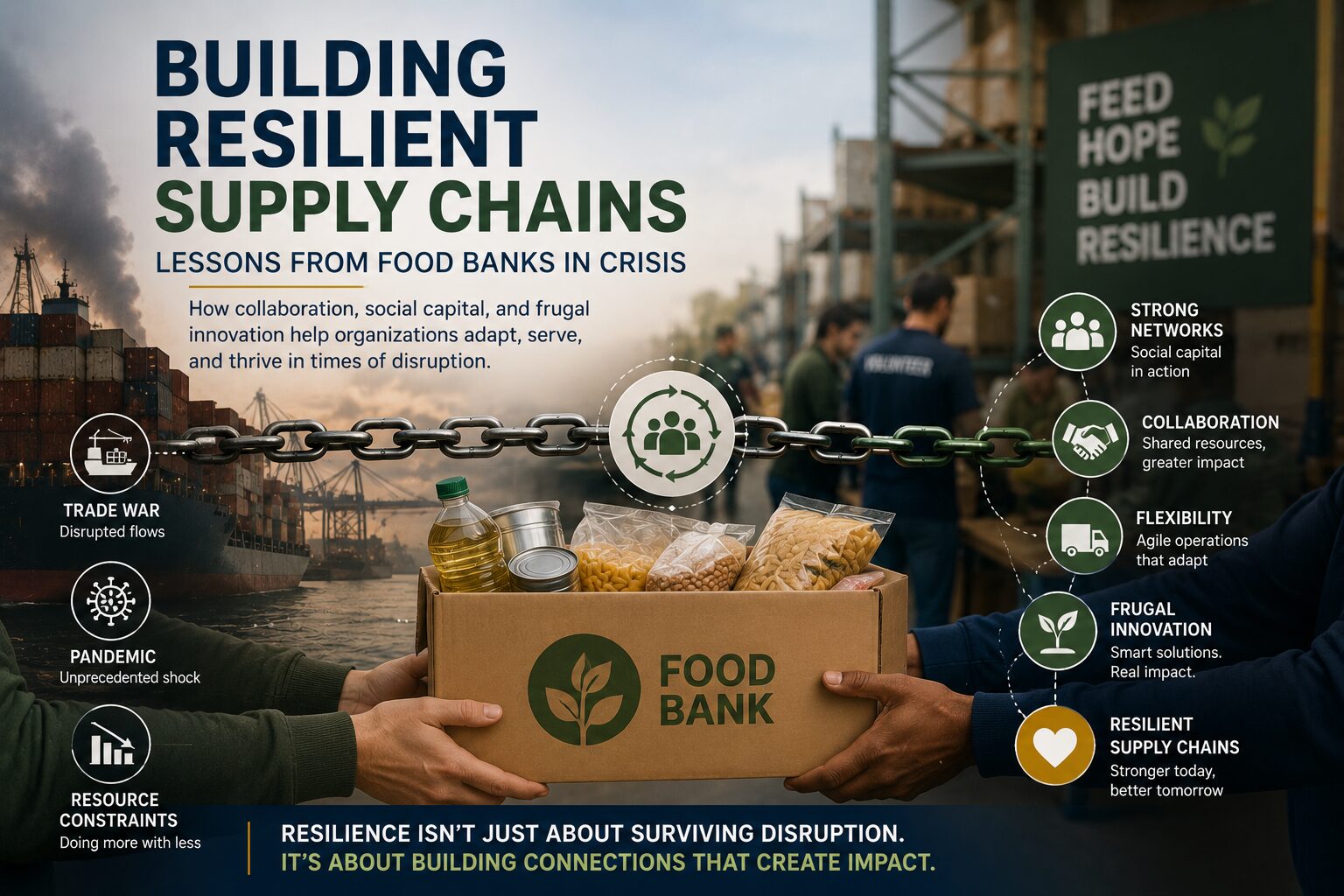
This research reveals how food banks, operating under extreme resource constraints, adapt and build resilience in their supply chains when faced with major disruptions like trade wars and pandemics. They leverage social capital, collaborative networks, and innovative resource mobilization to maintain critical operations.
Managerial implication
Managers should proactively invest in diverse, collaborative networks and foster strong social capital within their supply chains. Prioritizing flexibility, local sourcing, and a multi-stakeholder approach can significantly enhance resilience against unforeseen disruptions.
Broader relevance
The strategies employed by food banks offer valuable blueprints for any organization striving for supply chain resilience, particularly those operating in dynamic or resource-scarce environments. These insights are crucial for navigating a world increasingly prone to global shocks, extending far beyond the food sector.
Overview
In an era defined by unpredictable global events, the resilience of supply chains has moved from a niche concern to a top-tier strategic imperative. From trade disputes that reroute global commerce to unprecedented health crises like the COVID-19 pandemic, businesses worldwide have grappled with disruptions that threaten continuity and profitability. Understanding how organizations not just survive, but adapt and thrive in such turbulent times, is paramount for any forward-thinking leader.
This blog post delves into a fascinating study that examines the supply chain resilience of food banks, organizations that operate at the critical intersection of social welfare and logistical complexity. Often resource-constrained and serving vulnerable populations, food banks offer a unique lens through which to explore how resilience is built and maintained under duress. Their experiences provide invaluable lessons for businesses across all sectors looking to fortify their own supply chain strategies against future shocks.
What This Research Is About
The academic paper, "A trade way and a pandemic: Disruption and resilience in the food bank supply chain" by Blessley and Mudambi (2022), investigates how food banks navigate significant supply chain disruptions. Specifically, it explores the impact of the US-China trade war and the COVID-19 pandemic on their operations. The core research questions revolve around understanding the mechanisms food banks employ to maintain their supply of food and distribute it effectively to those in need during these crises.
The methodology employed in this study is qualitative, focusing on in-depth case studies of food banks. This approach allowed the researchers to capture the nuanced and dynamic strategies adopted by these organizations in real-time. By examining their responses to both a geopolitical trade conflict and a global health crisis, the study provides a rich empirical basis for understanding adaptive capacity and resilience in non-profit supply chains.
The scope of the research is particularly relevant for understanding frugal innovation, as food banks inherently operate with limited resources. Their ability to innovate and adapt under such constraints offers transferable insights for businesses seeking to build robust supply chains without necessarily relying on vast capital investments. The findings illuminate how social capital and collaborative networks become critical assets in times of crisis.
What the Study Found
The research uncovered several key findings regarding how food banks build and leverage resilience in their supply chains. A primary insight is the critical role of social capital and established networks. Food banks with strong relationships with donors, volunteers, and community partners were better equipped to mobilize resources and adapt quickly when traditional supply channels were disrupted.
- Diversification of Sourcing: Food banks actively diversified their food sources, moving beyond traditional retail donations to include direct agricultural partnerships, government programs, and even purchasing when necessary. This multi-pronged approach reduced dependency on any single source.
- Enhanced Collaboration: During crises, collaboration intensified not only with existing partners but also with new stakeholders, including local businesses and other non-profits. This collective action allowed for shared resources, expertise, and more efficient distribution.
- Operational Flexibility: The study highlighted the importance of agile operational models. Food banks demonstrated remarkable flexibility in their logistics, storage, and distribution methods, quickly reconfiguring operations to meet changing demands and restrictions.
- Leveraging Technology (Frugally): While not always high-tech, food banks often innovated with existing or low-cost technologies to improve communication, inventory management, and volunteer coordination, demonstrating frugal innovation in action.
These findings collectively illustrate that resilience in resource-constrained environments is not about having the most advanced systems, but about cultivating strong relationships, fostering adaptability, and creatively leveraging all available resources.
What It Means in Practice
For managers and entrepreneurs, the lessons from food banks are profoundly applicable, especially in today's volatile business landscape. The first practical implication is the imperative to invest in building robust and diverse networks. Don't wait for a crisis to forge relationships with suppliers, distributors, and even competitors. Proactive networking creates a reservoir of goodwill and potential support when disruptions inevitably occur.
Secondly, cultivate operational flexibility within your supply chain. This means designing systems that can quickly pivot to alternative suppliers, adjust production schedules, and reconfigure distribution channels. Regularly stress-test your supply chain for various disruption scenarios to identify weak points and develop contingency plans. Embrace a mindset of continuous adaptation rather than rigid adherence to established processes.
Finally, consider how your organization can foster social capital, both internally and externally. Strong internal teams that can communicate effectively and collaborate under pressure are invaluable. Externally, engaging with local communities and non-profit organizations can not only enhance your brand reputation but also create unexpected avenues for resource sharing and support during times of crisis. The 'frugal' approach of food banks teaches us that resilience isn't always about large capital outlays, but often about smart, collaborative resourcefulness.
Why This Matters for Scholars
This paper makes significant theoretical contributions to the literature on supply chain resilience, particularly within the context of non-profit organizations and resource-constrained environments. It extends our understanding of how social capital acts as a critical buffer against external shocks, moving beyond purely economic or technological perspectives. The study also enriches the frugal innovation discourse by demonstrating how organizations can achieve high levels of adaptability and effectiveness with limited means, highlighting the role of improvisation and network leverage.
For future research, this study opens several avenues. Scholars could explore the long-term impacts of such disruptions on the structure and governance of food bank networks. Further quantitative analysis could also be conducted to measure the specific economic benefits of social capital in enhancing supply chain resilience. Additionally, comparative studies across different non-profit sectors or even between non-profits and for-profit entities operating under similar constraints would provide valuable insights into the generalizability of these findings.
Final Takeaway
The core message from the resilience of food banks is clear: in an increasingly unpredictable world, a robust supply chain is not just about efficiency, but about adaptability, collaboration, and strong relationships. Organizations that proactively build diverse networks, foster social capital, and maintain operational flexibility are best positioned to weather any storm.
Embrace the lessons from these resource-frugal innovators. Their ability to deliver critical services under extreme pressure offers a powerful blueprint for any business aiming to build a truly resilient and future-proof supply chain, proving that ingenuity and collaboration can overcome even the most formidable challenges.
Comments are closed