

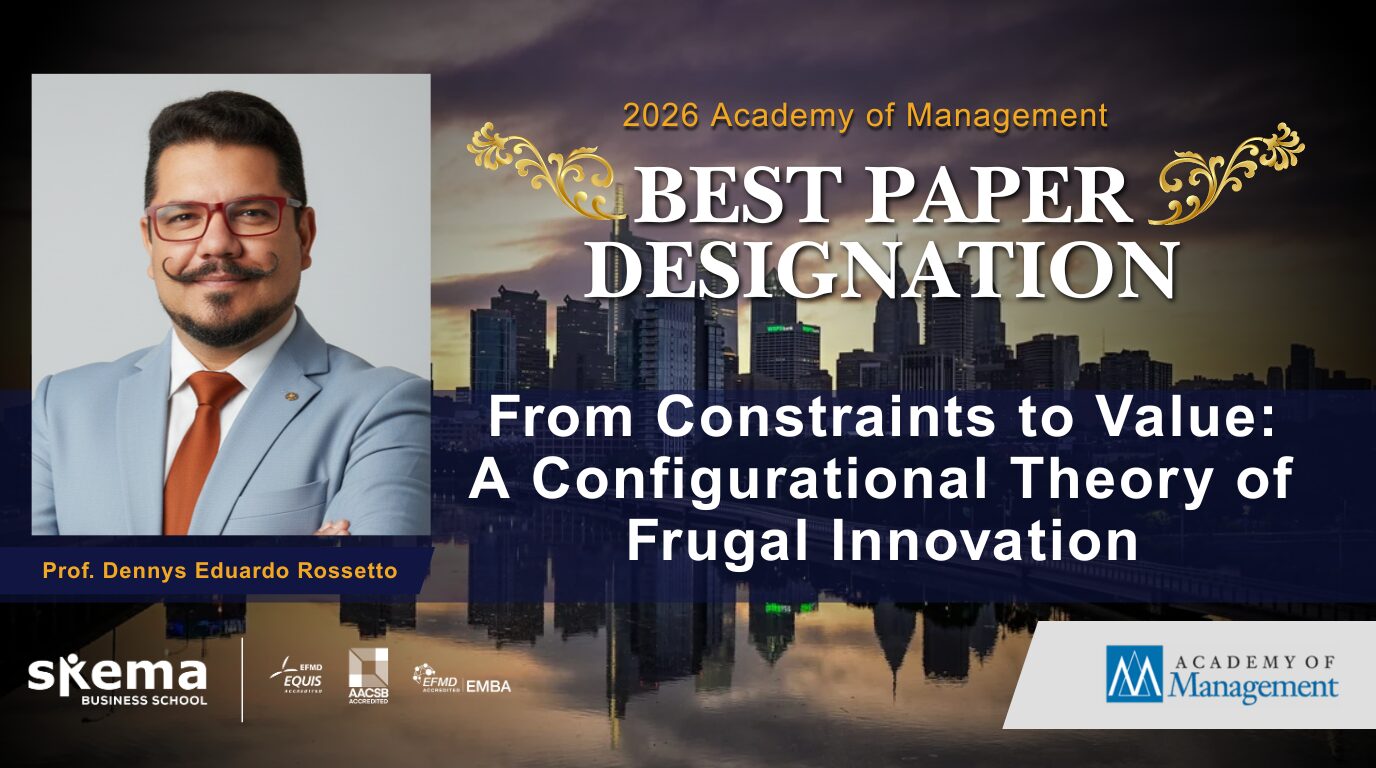
Recognition from the Academy of Management highlights research on how firms create value under resource constraints.
I'm very pleased to share that my paper, “From Constraints to Value: A Configurational Theory of Frugal Innovation,” has received a Best Paper Designation at the 86th Annual Meeting of the Academy of Management (AOM), which will take place in Philadelphia, USA, from 31 July to 4 August 2026. According to the official notification, the paper was judged by reviewers to be one of the best accepted papers in the program and was invited for inclusion in the Proceedings of the 2026 Academy of Management Meeting.
The study examines a central question in the frugal innovation literature: why some firms are able to innovate successfully under severe constraints while others struggle to scale or sustain value creation. Drawing on a systematic literature review through QCA Analysis (Qualitative Comparative Analysis, a set-theoretic research method that bridges qualitative and quantitative analysis, examining how combinations of conditions - causal configurations - produce specific outcomes) of 39 empirical articles covering 72 firm-level cases, the paper proposes a configurational explanation of frugal innovation outcomes rather than treating frugality as a single strategy or formula.
At a broad level, the paper identifies five recurring mechanisms that help explain how organizations innovate under constraints: cost and complexity reduction, resource repurposing, modularization, user co-creation, and institutional substitution. It also argues that these mechanisms combine in different ways, giving rise to three archetypal pathways: reverse-scaling bricolage, platform-levered frugality, and institution-bridging partnerships.
Without disclosing more than is appropriate at this stage, the paper’s broader message is that frugal innovation should not be understood as merely “doing more with less.” Instead, it's better seen as a set of distinct pathways through which firms align constraints, organizational responses, and context in order to create value.
The study also highlights that different pathways involve different trade-offs, especially in relation to scaling speed, inclusiveness, and long-term resilience.
I'm honored by this recognition from AOM and grateful for the opportunity to contribute to ongoing conversations on frugal innovation, innovation under constraints, and value creation in challenging environments.
More updates will follow after the conference.
Comments are closed