

ℹ In a Nutshell
Insight
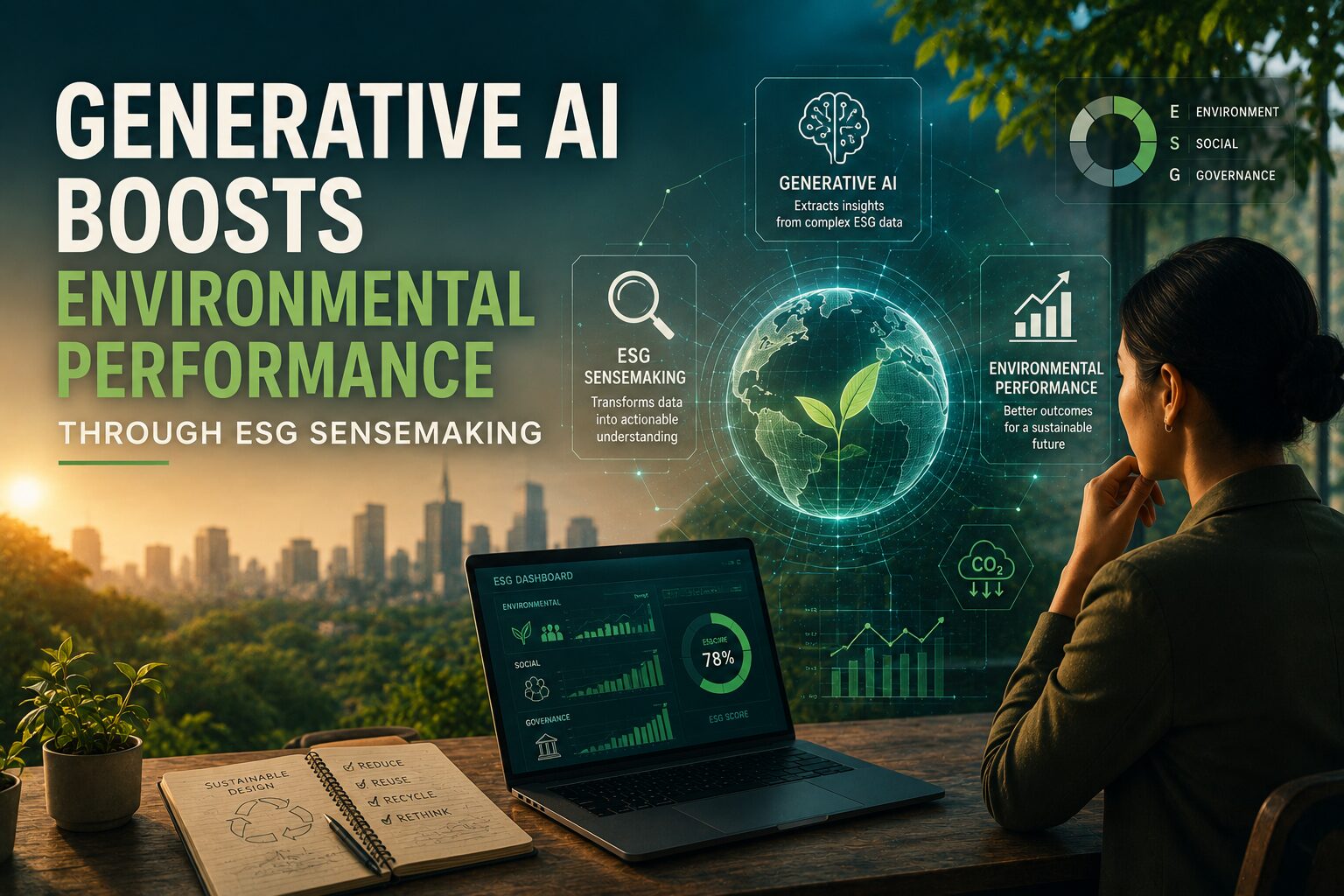
The integration of generative AI enhances environmental performance both directly and indirectly through improved ESG sensemaking capability
Managerial Implication
Organizations should focus on developing ESG sensemaking capability to fully leverage the potential of generative AI in sustainability management
Broader Relevance
The study highlights the importance of organizational interpretive capacity in achieving sustainability gains through technology adoption
Overview
As organizations increasingly adopt generative artificial intelligence (GenAI) to improve their sustainability management, a key question arises: how does GenAI translate vast ESG information into meaningful environmental outcomes? The enthusiasm for GenAI in sustainability management is growing, but it remains unclear whether the integration of such technologies can lead to significant environmental performance improvements. This managerial tension is at the heart of a recent study that investigates the relationship between GenAI integration, ESG sensemaking capability, and environmental performance.
The study’s findings have significant implications for managers seeking to leverage GenAI for sustainability gains. By examining the mediating role of ESG sensemaking capability, the study sheds light on the importance of organizational interpretive capacity in achieving environmental performance improvements through technology adoption. This insight is crucial for managers who may assume that technology adoption alone is sufficient to guarantee sustainability gains. Instead, the study suggests that organizations must develop their ESG sensemaking capability to fully leverage the potential of GenAI in sustainability management.
What This Research Is About
This study addresses the research question of how GenAI integration translates into environmental performance improvements, with a specific focus on the mediating role of ESG sensemaking capability. The study draws upon organizational information processing theory (OIPT) to develop and test a conceptual framework that examines the relationship between GenAI integration, ESG sensemaking capability, and environmental performance. The context of the study is sustainability management, where organizations are increasingly adopting GenAI to improve their environmental performance.
The study’s constructs include GenAI integration, ESG sensemaking capability, and environmental performance. The researchers collected data from 610 firms to test their conceptual framework, which includes the moderating effect of sustainability information overload and the influence of regulatory uncertainty on the relationship between ESG sensemaking and environmental performance. By examining these relationships, the study aims to contribute to the understanding of how GenAI can be leveraged to improve environmental performance and achieve sustainability gains.
What the Study Found
The study’s findings provide new insights into the relationship between GenAI integration, ESG sensemaking capability, and environmental performance. The researchers found that GenAI integration enhances environmental performance both directly and indirectly through improved ESG sensemaking capability. However, the study also found that the positive effect of GenAI integration on environmental performance weakens when sustainability-related information becomes excessive.
- The integration of GenAI enhances environmental performance both directly and indirectly through improved ESG sensemaking capability. This finding suggests that organizations can leverage GenAI to improve their environmental performance by developing their ESG sensemaking capability.
- The positive effect of GenAI integration on environmental performance weakens when sustainability-related information becomes excessive. This finding highlights the importance of managing sustainability information overload to fully leverage the potential of GenAI in sustainability management.
- Regulatory uncertainty amplifies the beneficial relationship between ESG sensemaking and environmental outcomes. This finding suggests that organizations operating in environments with high regulatory uncertainty can benefit from developing their ESG sensemaking capability to improve their environmental performance.
What It Means in Practice
The study’s findings have significant implications for managers seeking to leverage GenAI for sustainability gains. The following managerial implications can be derived from the study’s findings:
- Organizations should focus on developing ESG sensemaking capability to fully leverage the potential of GenAI in sustainability management. This implies that managers should invest in developing their organization’s ability to interpret and make sense of ESG information.
- Managers should be aware of the potential negative effects of sustainability information overload on the relationship between GenAI integration and environmental performance. This implies that managers should implement strategies to manage sustainability information overload and ensure that their organization can effectively process and interpret ESG information.
- Organizations operating in environments with high regulatory uncertainty can benefit from developing their ESG sensemaking capability to improve their environmental performance. This implies that managers should consider the regulatory environment in which their organization operates and develop strategies to mitigate the risks associated with regulatory uncertainty.
Questions Managers Should Ask
Managers seeking to leverage GenAI for sustainability gains should ask themselves the following questions:
- What is our organization’s current level of ESG sensemaking capability, and how can we develop it to fully leverage the potential of GenAI in sustainability management?
- How can we manage sustainability information overload to ensure that our organization can effectively process and interpret ESG information?
- What strategies can we implement to mitigate the risks associated with regulatory uncertainty and amplify the beneficial relationship between ESG sensemaking and environmental outcomes?
Limits and Responsible Interpretation
The study’s findings should be interpreted in the context of its limitations. The study does not establish the causal relationship between GenAI integration and environmental performance, and the findings may not be generalizable to all organizations. Managers should not conclude that the integration of GenAI alone is sufficient to guarantee sustainability gains, but rather that organizational interpretive capacity is important in achieving environmental performance improvements.
Why This Matters for Scholars
The study contributes to the understanding of how GenAI can be leveraged to improve environmental performance and achieve sustainability gains. The study extends organizational information processing theory (OIPT) by introducing ESG sensemaking capability as a distinct interpretive mechanism that bridges information-processing fit and sustainability outcomes. This theoretical contribution has implications for scholars seeking to understand the role of GenAI in sustainability management and the importance of organizational interpretive capacity in achieving environmental performance improvements.
Final Takeaway
The study’s findings highlight the importance of organizational interpretive capacity in achieving sustainability gains through technology adoption. Managers seeking to leverage GenAI for sustainability gains should focus on developing their organization’s ESG sensemaking capability and managing sustainability information overload to fully leverage the potential of GenAI in sustainability management. By doing so, organizations can improve their environmental performance and achieve sustainability gains, while also mitigating the risks associated with regulatory uncertainty.
📚 Original Article
Bag, S., Srivastava, G., Routray, S., & Chiarini, A. (2026). Generative AI, ESG Sensemaking, and Environmental Performance: an OIPT Perspective. Business Strategy and the Environment, 35(5), 7196-7217. https://doi.org/10.1002/bse.70520
Comments are closed