

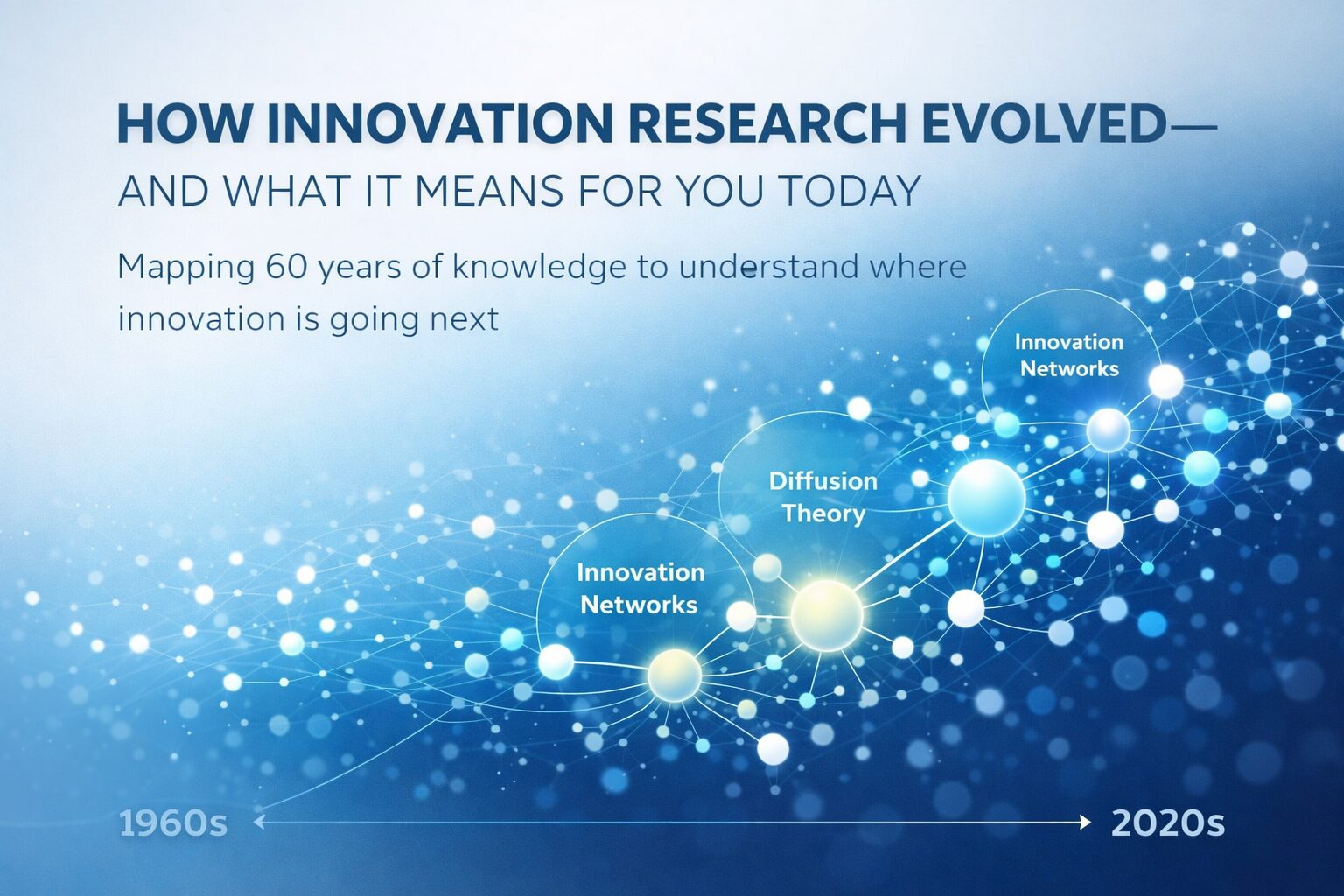
Innovation research has evolved through interconnected clusters shaped by influential authors, methods, and shifting themes over time.
Managerial implication
Understanding how ideas emerge and connect helps organizations anticipate trends and position themselves strategically.
Broader relevance
The structure of knowledge itself reveals how fields grow, mature, and open new opportunities for research and practice.
Mapping 60 years of knowledge to understand where innovation is going next
Innovation is often discussed as something new, disruptive, and forward-looking. Yet, behind every “new idea” lies a long trajectory of accumulated knowledge.
Understanding how innovation research itself evolves is critical because it allows us to:
- identify dominant paradigms,
- detect emerging themes,
- and anticipate where future opportunities may arise.
For managers, entrepreneurs, and scholars, this is not just academic curiosity—it is a strategic lens on the evolution of ideas.
What this research is about
This study provides a longitudinal analysis of the intellectual structure of innovation research, combining:
- bibliometric analysis, and
- social network analysis (SNA).
Unlike traditional literature reviews, the paper examines:
- who influences whom (citation and co-citation networks),
- how clusters of knowledge emerge, and
- how the field evolves over time.
The analysis spans six decades, offering a rare, systemic view of the innovation field.
What the study found
Innovation is a growing and highly dynamic field
The study shows a continuous and accelerated growth in:
- number of publications,
- number of authors,
- and diversity of research topics.
This reflects a field that is:
- open to new contributions,
- rapidly evolving,
- and increasingly interdisciplinary.
Knowledge is structured in clusters
Innovation research is not random—it is organized into clusters of interconnected ideas and authors.
These clusters:
- represent subfields or schools of thought,
- evolve over time,
- and sometimes remain stable across decades.
Some clusters persist, showing conceptual stability, while others emerge or disappear, indicating shifts in attention and priorities.
A few key works shape the entire field
The analysis highlights foundational contributions from authors such as:
- Nelson & Winter (evolutionary theory),
- Cohen & Levinthal (absorptive capacity),
- Rogers (diffusion of innovation).
These works act as intellectual anchors, structuring the field and influencing generations of research.
The field is driven by networks—not isolated ideas
One of the most important findings is that innovation research evolves through networks of relationships:
- between authors,
- between papers,
- and between ideas.
The concept of “invisible colleges” highlights how informal networks of researchers shape the development of knowledge.
Increasing complexity and methodological diversity
Over time, the field shows:
- more interconnected research areas,
- more authors involved,
- and greater use of diverse methods (including case studies and advanced analytical approaches).
This reflects a move toward: more complex, systemic, and multi-method approaches to studying innovation.
What it means in practice
For managers
Innovation is not just about new ideas; it is about positioning within evolving knowledge systems.
Firms can gain an advantage by tracking emerging themes,
- connecting distant domains,
- and leveraging cross-disciplinary insights.
For entrepreneurs
Opportunities often emerge at the intersection of clusters. New ventures can:
- recombine existing knowledge,
- explore underdeveloped areas,
- or bridge disconnected domains.
For scholars
The field offers high openness and opportunity for contribution.
Future research can:
- integrate disconnected clusters,
- explore emerging topics,
- or apply new methodologies.
Why it matters for managers, entrepreneurs, and scholars
This study changes how we think about innovation:
- Innovation is not only about creating new things.
- It is also about understanding how knowledge itself develops.
Those who understand:
- the structure of knowledge,
- the dynamics of research,
- and the emergence of new clusters,.
are better positioned to:
- lead innovation,
- anticipate change,
- and shape future trajectories
Limits and cautions
The study relies on:
- citation and co-citation data,
- and assumptions about how citations reflect influence.
However:
- citations may not always reflect true intellectual impact,
- and classification methods (e.g., databases) have limitations.
Therefore, results should be interpreted as: a structured approximation of the field, not a perfect representation.
Final takeaway
Innovation evolves through networks of ideas, not isolated breakthroughs. Understanding these networks allows you to:
- see where the field has been,
- understand where it is now,
- and anticipate where it is going.
Comments are closed